Plants vs Profit: The Return on Investment of Office Planting Explained
:format(webp))
:format(webp))
Key Takeaways
Productivity rises when offices are enriched with planting Productivity rises when offices are enriched with planting
Plants pay for themselves Rather than costing a business, plants generate net financial gain through increased worker productivity, reduced sick days and other measurable benefits.
ROI is consistently strong across office sizes As productivity improvement is proportional, both offices large and small benefit
The real value of putting plants into offices.
Plants are an investment, whatever space they are in.
They encourage hospitality guests to spend more, and they help keep the people who drive businesses forward calm and collected. In many settings, planting can be a genuine deciding factor between profit and loss in a modern business.
So when is the right time to make that investment, and how confident can you be in achieving meaningful returns?
Here, we explore the proven benefits of plants in the workspace, the pioneering research that outlines the return on investment you can expect to see, and the real numbers, backed by scientific evidence, that can support and justify your planting spend.

What are the benefits of Plants in a workspace
For this piece, we are going to strictly be exploring the return on investment (ROI) of plants in office environments. We've explored benefits of planting in hospitality in a separate article.
We love talking about the benefits of bringing greenery into your office. Plants can help your team feel more creative, they can improve productivity and reduce sick days, and they can even contribute to a greater sense of workplace satisfaction. Beyond all of these benefits, however, is their ability to seriously ramp up workplace productivity...
Pioneering the science behind this is Dr Craig Knight of the University of Essex, one of the most influential voices in the field of workplace psychology and biophilic design. His research has shaped much of what we now understand about how environments affect performance, and his findings have helped businesses around the world quantify something that once felt intangible.

From lean spaces to enriched environments
For his research, Dr Knight compared so called enriched offices with lean offices. Lean working draws on historic industrial principles, from Wedgewood pottery to modern production systems, where the aim is to maximise value by stripping out anything deemed inefficient. In practical terms, this meant desks and offices devoid of anything enriching. No plants, no artwork, no personal items. The assumption was that fewer distractions would lead to fewer errors.
But, as Dr Knight quickly found, no species thrives in barren environments. Contrary to popular belief, empty offices were not efficient at all. They were stressful, demotivating, and harmful to performance.
As he puts it: “No animal thrives in a stark, empty environment. So why would humans be the exception?”
To test his theory - that an environment enriched with planting would produce more, Knight and his colleagues introduced a handful of inexpensive plants and ran controlled studies comparing lean and enriched spaces.
The results were clear and consistent. Even modest enrichment helped people feel better, work better, and perform better. Plants proved especially effective because they were affordable, robust, and naturally engaging.
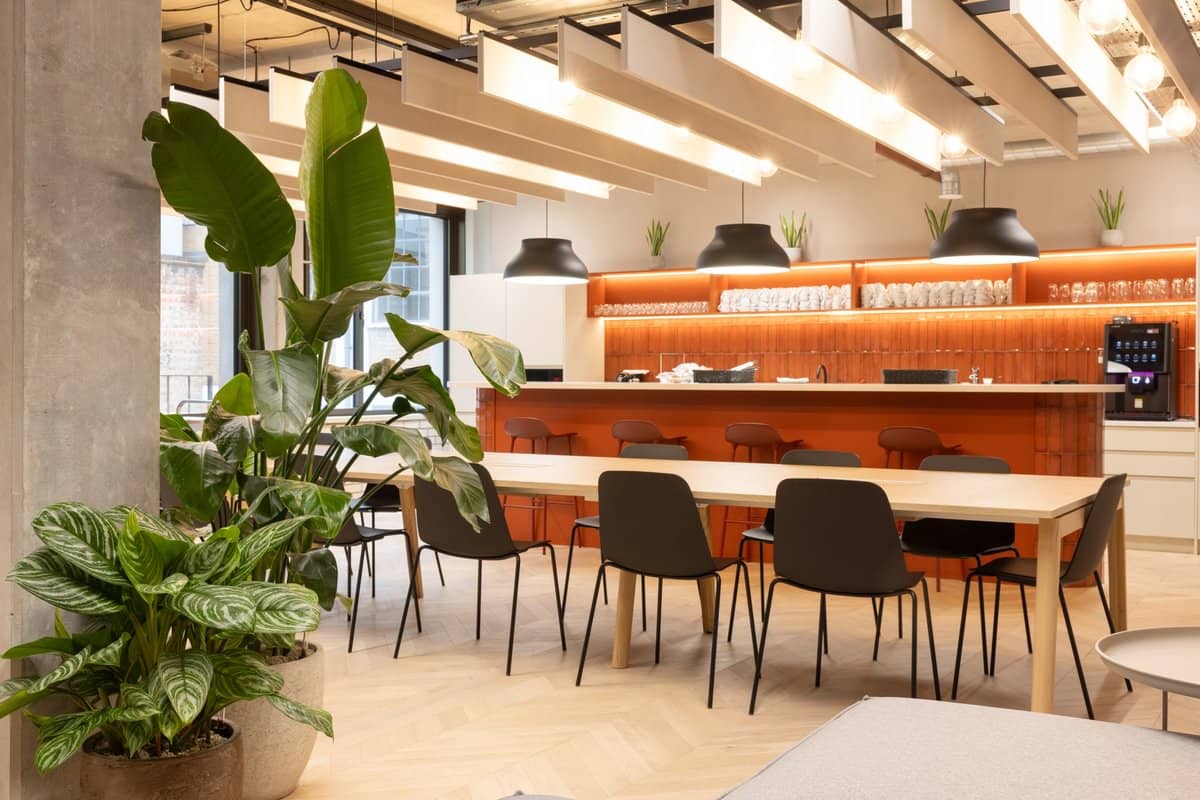
Breaking down the productivity increase
From his experiments, Dr Knight concluded that plants made workers 15% more productive - a truly staggering statistic. When translated into revenue, equated to between one and five million pounds in additional output.
What makes these results so compelling is the way productivity was measured. Instead of vague indicators, Knight’s team broke each job role into its essential components, and measured how these changed across the control 'lean' and enriched working environments.
For auditors this meant analysing accuracy, attention to detail, speed of processing, and how well management information was used. For HR, marketing, or leadership roles, the components differed, but the principle remained the same.
This granular approach allowed them to circumnavigate any sentiment or emotion in their results - they were as quantitative as possible.
The numbers: What is the ROI of introducing office planting?
Using this productivity data from Dr Knight, we can begin to see the real financial benefits of bringing planting into the workspace. We used his data, along with other studies to model the ROI below.
Modelling the ROI of plants in offices
To understand the real financial impact of planting, we modelled a conservative, real world scenario using UK market data from 2024. The example assumes a standard office of one hundred employees, each generating an average of one hundred and twenty thousand pounds in revenue per year.
Using the WELL Standard as a benchmark, this organisation would require around three hundred and seventy five square feet of biophilic coverage. Converted into individual plants, this equates to roughly seventy five medium sized plants across the floorplate. The annual cost of renting and maintaining these plants is eleven thousand two hundred and fifty pounds.
The calculations - first the benefits
A Meaningful Productivity Uplift
A fifteen percent improvement in productivity across one hundred employees generating one hundred and twenty thousand pounds each results in:
• £1,800,000 of additional output per year
This is the single largest driver of ROI.
Benefit: Reduced Sick Leave
Plants contribute to healthier indoor environments, which can decrease minor illnesses and discomfort.
Using the UK average of 5.8 sick days per employee per year and applying a conservative fifteen percent reduction:
• 87 sick days saved annually
• Worth £12,692 in reclaimed productivity
Total Annual Value Created
When combining productivity uplift and reduced absenteeism, planting delivers:
• £1,812,692 of total yearly value
The cost of planting
Extremely Low Operating Costs
The annual cost of a professionally maintained planting scheme:
• £11,250 per year
Compared to the returns, this operational cost is minimal.
Final Planting ROI
Against the annual investment of £11,250, the results are extraordinary:
• Net annual return: £1,801,442
• ROI: 16,013 percent
• Payback period: less than one month
The Bottom Line
These figures are, of course, estimates. Even so, they offer a clear view of the very real value that planting can bring to an organisation. It is also worth noting that this kind of ROI scales in a linear way. Whether an office is larger or smaller, the proportional return remains consistent.
For the latest data, and to explore the calculations in full, head over to our Planting planting ROI calculator
Planting pays for itself almost immediately, then continues generating value every single day. For many organisations, the question is no longer whether they can afford to invest in planting, but whether they can afford not to.

Using planting properly to unlock productivity
The evidence is clear. Plants can generate remarkable returns, but those returns depend on using planting in the right way. Productivity increases do not come from a single pot plant in the corner. They come from intentional, visible, well designed planting that genuinely enhances the working environment.
The Conditions That Unlock Productivity
Plants must be visible: In every major study, the positive effects of planting only occur when employees can actually see and interact with greenery in their normal field of view. Hidden plants or poorly maintained specimens will not deliver results.
There must be enough planting per person: A single desk fern will not transform an office. Biophilic standards, including WELL, are clear about coverage requirements for real impact. Density matters because it influences humidity, visual comfort and psychological restoration.
Plants must be used correctly within the space: Different zones require different planting strategies. Open plan floors may need taller planting for privacy, circulation routes need robust species and quiet zones often benefit from softer, calming foliage. As we outline in our design literature, the right plant in the right place creates the right effect.
When these conditions are met, planting becomes more than decoration. It becomes a tool for supporting focus, comfort, wellbeing and performance. The ROI model shows just how powerful that can be. With productivity uplifts of fifteen percent and meaningful reductions in absenteeism, planting consistently proves itself as one of the highest value investments a workplace can make.
Conclusion
The impact of plants in the workplace is broader and more substantial than one might imagine.
A shift in the physical working environment ripples into meaningful changes in how people feel, focus and perform. This research, along with decades of supporting evidence, shows that enriched environments consistently outperform lean ones.
When offices include visible, well placed planting, employees report higher comfort, fewer minor health complaints and a stronger sense of connection to their workspace. Productivity rises not only because plants are amazing (at least we think they are...), but because people thrive in environments that feel supportive, calming and thoughtfully designed.
If you would like to see how Plant Plan can bring the power of plants into your office or workspace, please have a look around our site - you can see our case studies here!
Or if you would like to see exactly how we can help you, please get in touch.
:format(webp))
:format(webp))
Unpacking the studies of Prof. Dr Tøve Fjeld
Professor Dr Tøve Fjeld conducted a series of fascinating studies in the 1990s that give us an incredible insight into the physical effects that plants have on humans. Across three different studies, in different locations, different times, different people, there are very similar, conclusive results that demonstrate just how powerful plants are.
:format(webp))