Why Are Living Walls the Best Way to Maximise Greenery?
:format(webp))
:format(webp))
Introduction
We all want a greener workspace… at least, we certainly do here at Plant Plan.
The challenge is that it’s often much easier said than done. Limited floor space, busy walkways, fire escape requirements, budgets, and ever-changing workplace layouts can all make it difficult to introduce more planting.
That’s where green walls come into their own.
By making use of an often-overlooked resource – vertical space – green walls allow you to introduce significant amounts of greenery without sacrificing valuable floor area. After all, there’s usually far more wall space than floor space available, yet it often remains completely blank, underused and, if you ask us, a little uninteresting.
Why are green walls the best way to maximise greenery?
Because they can contain hundreds of plants within the footprint of a single trough planter, green walls make incredibly efficient use of vertical space instead of valuable floor area.
Living walls can also be surprisingly easy to maintain. With integrated irrigation systems, watering is largely automated, while preserved moss and replica green walls offer an even lower-maintenance way to create a lush, green environment.
Most importantly, green walls are designed to be seen! They fill your field of vision with greenery and, as we’ve explored before, simply looking at plants is one of the primary ways we experience the benefits of biophilic design. Rather than sitting quietly in the corner of a room, a green wall becomes an immersive focal point, ensuring those green views are almost impossible to miss.
Floor Space Is Your Most Valuable Asset
As the way we use workplaces has evolved, so too has the modern office. Today’s spaces are expected to accommodate collaborative areas, clear circulation routes, and accessible layouts, all while making the most of every square metre.
Every floor standing planter occupies valuable floor space. A green wall, on the other hand, transforms an unused vertical surface into a thriving planted feature, delivering far more greenery without compromising the workspace.

Green walls deliver more plants per square metre
It probably seems obvious that a green wall takes up less space than the equivalent amount of floor-standing planting. But just how big is the difference? We thought we’d do the maths.
Let’s take a typical 3m × 2m living wall. Depending on the system, it will usually project around 200–300mm from the wall. To keep things conservative, let’s assume 300mm.
That means it occupies just 0.9m² of floor space (3m × 0.3m), while providing 6m² of planted surface.That’s over six times more planted surface area than the floor space it occupies.
In other words, for roughly the same floor footprint as a single large trough planter, you gain an entire living wall featuring:
Hundreds of plants
Rich, layered textures
Significantly greater leaf coverage
A far more striking visual impact
When you look at it that way, it’s a bit of a no-brainer.
Living walls turn dead space into living space
Crucially, living walls bring greenery to spaces that are otherwise very difficult to plant. Think lift lobbies, narrow corridors, or feature walls where floor-standing planters would simply get in the way.
Imagine this: you’ve created a beautiful office, filled with living greenery. Then you head upstairs and suddenly it all stops. You’re met with a barren, grey stairwell. Not so biophilic now, is it?
A green wall allows your planting scheme to continue into these transitional spaces, creating a more seamless and immersive experience rather than one that feels stop-start. The result is a workplace that feels consistently connected to nature, rather than green in some places and empty in others.
They’re particularly effective in places such as:
Reception walls
Lift lobbies
Corridors
Breakout spaces
Stairwells
In these areas, where floor-standing planting simply isn’t practical, a living wall can transform an otherwise blank surface into a vibrant focal point without compromising the way people move through the space.
What is better, a living or replica green wall?
One of the biggest questions we get asked is whether a living or replica green wall is the better choice. The answer, as with most things in planting design, is that it depends entirely on the space, and your maintenance requirements, even to a degree, it depends on the rest of your scheme…
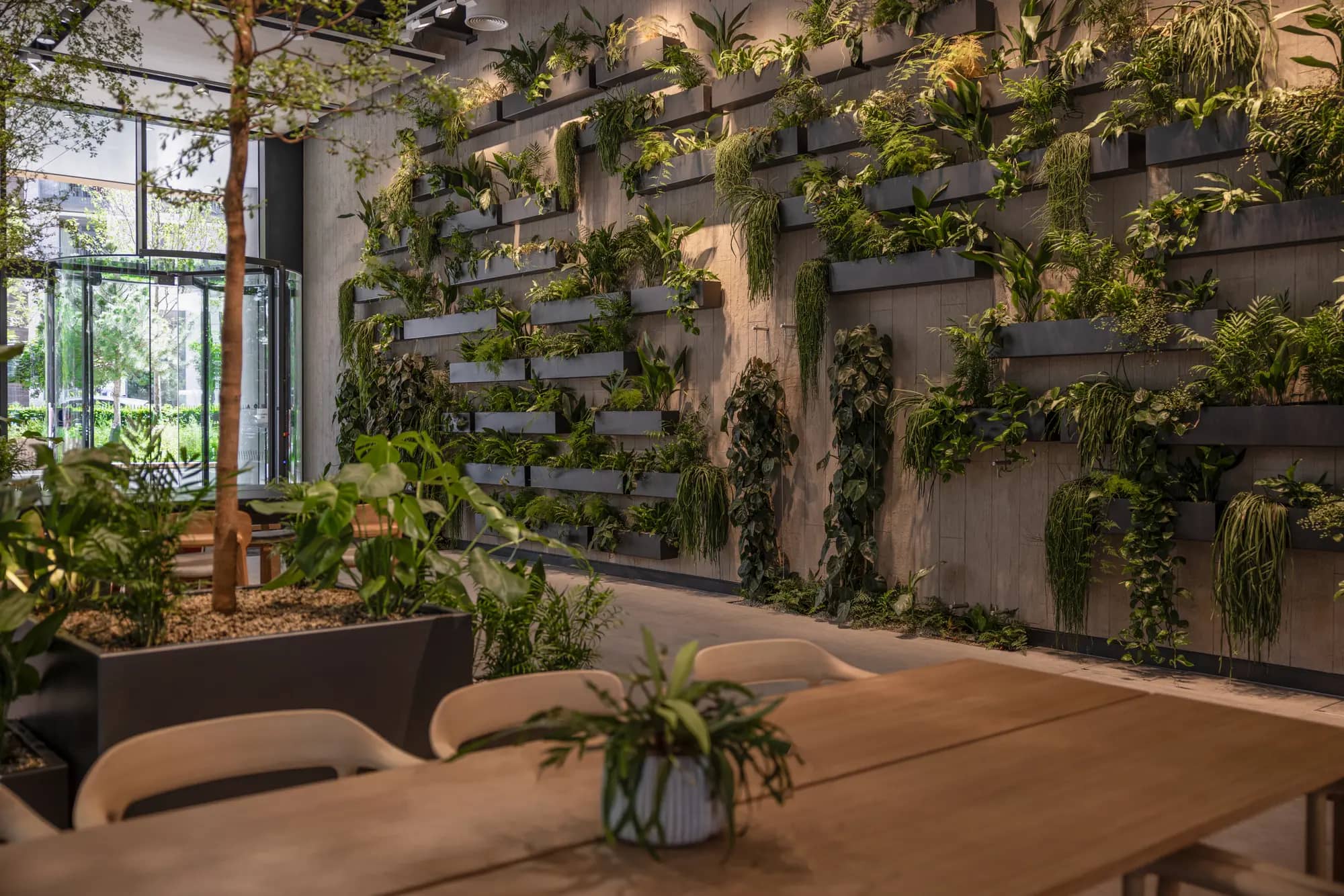
A living green wall has many benefits:
· It delivers all the beauty of natural planting.
· It grows and changes over time, bringing more dynamism to a space,
· They can be more tactile and interactive (with caution!)
Living walls are often seen as the premium option, when compared to their replica cousins. To thrive, however, they require the right conditions, along with integrated irrigation and ongoing professional maintenance. That is where things can get tricky.
If they are in hard-to-reach places, they can be very difficult to maintain, and irrigation systems can present challenge, especially when they decide they don’t want to work any more…
A replica green wall, on the other hand, offers many of the same visual benefits with virtually no maintenance:
Because it doesn’t rely on natural light or irrigation, it can be installed in locations where a living wall simply wouldn’t be viable, such as darker corridors, internal lift lobbies, or areas where access to water is limited.
Modern replica planting is also incredibly realistic, making it a popular choice for commercial interiors.
Ultimately, both options achieve the same goal: maximising greenery while making the best possible use of vertical space.
There is also the option of preserved or moss walls, the benefits of which we have written about extensively.
The right solution depends on your environment, budget, and long-term objectives. In many projects, the most effective approach is even to combine the two, using living walls where conditions allow and replica installations where practicality demands it.
When isn't a living wall the best option?
As much as we love green walls, they’re not always the right solution. Good planting design isn’t about forcing a particular product into every project; it’s about finding the right solution for the space.
For example, a green wall may not be the best option if:
The office is extremely small and only requires a handful of plants.
The available budget is better suited to floor-standing or integrated planting.
The walls aren’t structurally suitable for supporting a living wall system.
The space is temporary, making a permanent installation impractical.
In these situations, feature planters, integrated furniture planting, or carefully positioned floor-standing plants can often achieve a greener, more flexible workplace.
The goal is always the same: creating the greatest possible impact with the space available.
Living wall FAQs
For maximising greenery, they are. Living green walls use vertical space to accommodate significantly more planting while leaving floors clear. However, traditional planters still play an important role in creating layered planting schemes, and there are many times where other planting solutions can be much better suited to a space!
Yes! Because they’re installed vertically, green walls provide substantial planting without occupying your valuable floor space.
Research suggests that greater exposure to greenery can support wellbeing, reduce stress, and improve satisfaction with indoor environments. Green walls can help create these immersive green views as part of a wider biophilic design strategy.
Professionally installed living walls are designed with integrated irrigation systems and are typically maintained through scheduled servicing. Replica green walls require very little ongoing maintenance beyond occasional cleaning.
Reception areas, breakout spaces, meeting rooms, cafés, lift lobbies, and feature walls are among the most popular locations, where they maximise visual impact without reducing usable space. This also relies on those areas having enough natural light. If not, auxiliary lighting can be used!
Final thoughts
Green walls are one of the most effective ways to maximise greenery in any space. By transforming unused vertical surfaces into lush, living features, they deliver more planting, greater visual impact, and all the wellbeing benefits of biophilic design without compromising valuable floor space.
If you’re considering a green wall for your workplace, our team at Plant Plan would love to help. . Get in touch today to start designing a wall that’s perfectly tailored to your space.
:format(webp))
What do office plants cost?
Curious about the cost of office plants from a plant company? This blog breaks down typical budgets for various workspace planting features, from floorstanding pots to living walls. Whether you're adding greenery to desks, walls, or bespoke joinery, you'll find helpful estimates to make the most of your budget. Inside you'll find both purchase prices and the cost to hire office plants.
:format(webp))
:format(webp))